In today’s post, I would like to reveal the issue related to our arms. The shoulders are an area in which each of us has felt some pain or some other discomfort from time to time. But even before we take them by storm in order to increase their volume, it is good to keep in mind a few of the following little things.
As mentioned in the title, the shoulders are not just about the three muscles, the anterior, middle and posterior deltoid muscles. It’s a bit more complicated. If we talk about the shoulders, we will actually be talking about the shoulder girdle, which is made up of multiple joints. The shoulder joint itself (glenohumeral joint) is only one part. It should not be forgotten that the shoulder girdle also includes the scapula and collarbone (scapulothoracic joint, acromioclavicular and sternoclavicular joint). We can already see here that this whole puzzle will consist of a tangle of ligaments, tendons and, most importantly, muscles.
If we were to transfer the whole thing into motion, it is good to realize that part of the whole shoulder girdle, and therefore the shoulder joint, is the most mobile joint on our body. And it is the other joints that should be stable enough to be able to load both the upper limb itself and our entire axial-support system as optimally as possible. Here again, I will mention something that has already been said, namely that sufficient mobility should precede good stability, but it also works synergistically the other way around, that sufficient stability should precede good mobility. We should always be able to look at the issue from several sides. This pun could guide us on how we might approach the development of our arms.
The load hierarchy could look like this. At the beginning of the training, we could turn our attention to mobility and stability. Mobility in the area of muscles that are responsible for internal rotation in the shoulder joint, as these muscles are often overloaded in most cases. After mobilizing them, we could proceed, technically speaking, to centering the scapula and activating the muscles that are involved in its stabilization, as well as movement. This point is very important when moving on to the next steps, because a properly stabilized scapula allows us to better activate the muscles that we will focus on in the next step, which are the muscles that make up the rotator cuff. This is very important for our shoulder joint – these muscles are responsible for integrating the head of the humerus into the glenoid fossa, which should sufficiently center the joint. After mastering these steps, we could proceed to a more complex load, especially in the area of our core and lower limbs. Because core development exercises as well as lower limb development exercises will be used to further improve kinetic energy transfer as well as proximal stability, all of which will lead to better mobility in the upper limbs.
The conclusion after such a comprehensive warm-up will be that lifting loads, whether in everyday life or loading iron in the gym, will be much safer and, above all, more painless for our shoulders and the whole body. As I mentioned, it’s not a guide, just a little advice on how we could mix it, but as one well-known judge said in a TV show: “you can’t try it – you don’t know”.
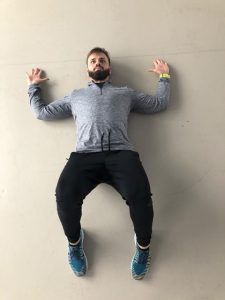
1. Mobilization exercise: “Floor slide” – which in Slovak equivalent we can say very simply sliding on the floor – performed lying on the back, the upper limbs are bent in the arm and the surface of the entire arms is in contact with the floor. The movement begins with exhaling, moving the arms above the head and inhaling back. We only move overhead as long as we can keep the surface of our arms in contact with the floor. The exercise affects the flexibility of the internal rotators of the shoulder joint as well as the entire shoulder girdle.

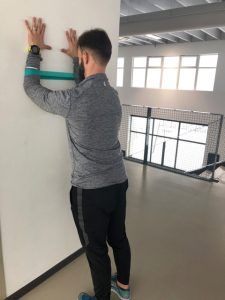
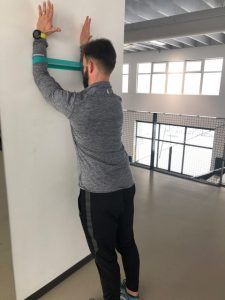
2. Stabilization exercise: “Arm elevation against a wall” – which in Slovak can be said as moving the arm along the wall, against the resistance of the miniband. The exercise facilitates the rotator cuff and affects the stabilization of the scapula. The exercise can be performed statically, which means that we get into the correct setting in the support by the forearm and create a slight pressure against the miniband. Likewise, the movement of the arms along the wall above the head and back can be added to the exercise, the emphasis is on constant pressure into the miniband, as well as on the fact that our shoulder blades remain stabilized at all times and do not move up and back together with the arms.
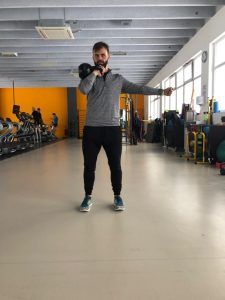
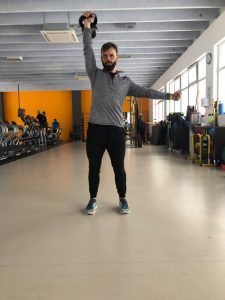
3. Strengthening exercise: “Army press” – more precisely one-handed overhead press – an exercise that has a positive effect on strengthening the entire shoulder girdle as well as strengthening our core body. By regularly including the exercise in our training, we will feel an improvement not only in pressure but also in pulling exercises. Likewise, if we perform the exercise unilaterally, we compensate for the muscle imbalance between one side of the body and the other.